Completion isn't competence: your dashboard is lying
2026-07-07 · The alltutors.ai team
TL;DR
- Completion measures whether someone opened the material and clicked through to the end. Competence measures whether they can do the task afterward, without the material in front of them.
- A 90%+ completion rate can sit next to near-zero retention. People finish content all the time without absorbing it.
- Vanity metrics (completion, seat time, click-through) look good on a dashboard. Signal metrics (retrieval without notes, applied practice) predict real performance.
- A practice loop, try it, get feedback, try again, builds competence. One-way content delivery doesn't, no matter how polished it is.
- If you can only track one thing before your next rollout, track whether people can do the task, not whether they sat through the material.
What completion actually measures
Completion measures attendance: did someone open the material and click through to the end. Competence measures whether they can do the task afterward, under real conditions, without the material in front of them. Most training dashboards only measure the first one, and most training decisions get made as if they measured the second.
That gap is not a rounding error, and inside a company it hides in plain sight. Completion here is high because it's assigned. Onboarding is mandatory in week one. Compliance training runs to a regulator's deadline. So the number climbs to 90%, 100%, right on schedule, and gets reported up as if it certified capability. It certified attendance. In the wild, most voluntary courses die young: one analysis put the median online completion rate at 12.6%, with self-paced programs often below 5% (communipass.com). Inside a company the opposite failure is the quiet one. A cohort can finish at 90% and still fail the exact task the course was supposed to prepare them for, because finishing a course and absorbing it are not the same thing.
Why this happens
Passive content, slides, a recorded video, a PDF, asks almost nothing of the person consuming it. Advancing to the next screen requires a click, not a memory. A learner can have the tab open, the video playing, and their attention somewhere else entirely, and the system will still log 100% complete. Completion is a proxy for exposure. It was never a proxy for understanding, but it's the easiest thing to log automatically, so it became the default metric almost by accident.
Competence asks you to produce the answer, not recognize it in a list. Recognition is easier than recall. A completion checkbox can't tell the two apart.
Completion also has a timing problem. Understanding fades on its own schedule, whether or not anyone checks in on it. Someone can genuinely get a concept the day they finish a module and lose most of the specifics within a few weeks, because nothing brought it back in between. Completion is measured the second someone clicks through. It tells you nothing about what's left a month later, which is when it matters: the customer call, the audit, week one on the new system.
What this looks like across three teams
Whether you own new-hire ramp, rep enablement, or mandatory compliance, the same gap shows up in a different costume.
If you run onboarding: a new hire finishes every module in week one, every box checked, every video watched. The 30/60/90 dashboard is green and time-to-productivity looks on track. Three weeks in, you're fielding the same questions the modules already answered. That's your ticket-deflection number failing quietly while completion says everything's fine. Watching a module once is not the same as recalling it under pressure, and nobody measured the second.
If you run rep ramp: the new pitch shipped in a 50-page enablement deck, the rep passed the multiple-choice cert, and by their first discovery call the messaging had already shifted once. You own 8 reps and can role-play with maybe 2-3 a week, so nobody heard this one handle a live objection before a prospect did. On the call, the prospect raises something that wasn't one of the four answer choices, and the rep freezes. Picking the right answer off a quiz is a different skill from producing it live, which is the whole point of certifying a rep is ready before they go customer-facing. (More on why practice conversations beat slides for sales ramp in a separate post.)
If you own compliance: 100% completion on the annual security-awareness training, on schedule, every year. Then someone who "completed" the module twelve months ago clicks the phishing link. The completion record passes the audit. The clicked link is the incident the training existed to prevent. Those are two different deliverables, and only one of them shows up on your dashboard.
Nobody slacked off. The wrong thing got measured. Each team checked that the training ran, not whether anyone could still do the thing weeks later.
Vanity metrics vs signal metrics
Two columns most dashboards never show:
| Metric | What it tells you | What it misses |
|---|---|---|
| Completion rate | Someone opened the content and reached the last screen | Whether they understood or retained any of it |
| Seat time / time-on-page | How long a window was open | A tab can sit open while someone answers email |
| Click-through rate | Someone advanced through slides or a video | Passive advancing isn't recall |
| Quiz pass rate (multiple choice, no time gap) | Someone can pick a right answer out of four | Recognition is much easier than recall or application |
| Retrieval accuracy (asked later, no notes) | Someone can produce the right answer without the material open | Closer to how they'll actually perform on the job |
| Applied practice score | Someone can do the task in a realistic scenario, a call, a decision, a workflow step | This is the thing you were actually trying to build |
The first three rows are what most LMS dashboards default to, because they're free: the system already knows who opened what. The last two rows require the training to ask something back. That's a design decision, and most teams never make it.
The shape of the difference
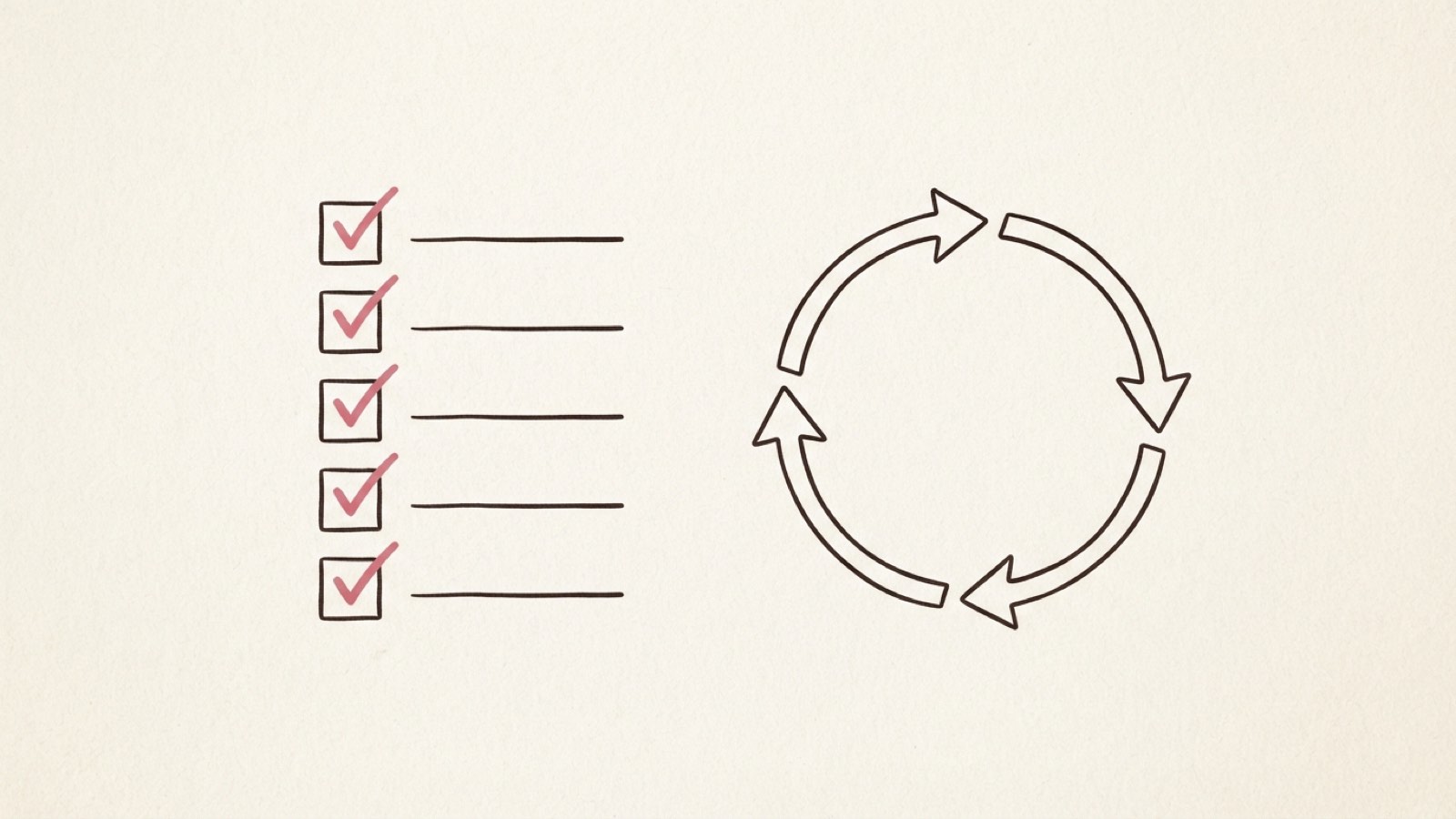
A completion funnel is a straight line with a dead end. Once someone reaches the bottom, the system stops asking anything of them, and you stop learning anything about them. A practice loop has no dead end: try it, get feedback, adjust, try again. Each pass produces a new data point about what the person can actually do. The funnel gives you one reading. The loop keeps giving you new ones.
What to change first
You don't need to throw out existing material to fix this. Slides, docs, and recordings can stay as the source of knowledge. What changes is the checking layer sitting on top of them: instead of a "mark complete" button, ask the person to produce an answer, handle a scenario, or walk through a step, with the source material closed. That one change is the difference between a completion log and evidence someone can do the job.
The signal looks different for each team. For onboarding, it's whether the hire can complete the real task without opening a ticket. For sales, it's whether the rep can hold an objection live before a prospect hears them. For compliance, it's whether the risky behavior actually dropped, while you still keep the completion record for the audit.
Two smaller changes compound the effect. First, space the checks out instead of front-loading them all at the end of a module. A short question a week later catches what a same-day quiz can't, because it tests what actually stuck, not what's still fresh from today's session. Second, report the two kinds of metric separately instead of blending them into one dashboard number. Show a manager "94% completed, 61% could answer correctly a week later" and they get the truth. Show them "94% completed" alone and they get a number that looks like proof of nothing.
That second number is also what lets you defend the line item. "94% completed" is what gets L&D called a cost center. "61% could still do it a week later, up from 38% last cycle" is a capability gain you can put in front of the VP who decides whether your budget survives the next round of cuts.
This is the design argument behind a tutor that holds a conversation instead of just serving content. It asks a follow-up and checks the answer, so understanding gets checked in the conversation itself, instead of a quiz bolted on at the end. Our quickstart guide walks through building one from your own material in a single sitting. If you're weighing a team rollout, our enterprise page covers how that reporting reaches a manager, and you can book a walkthrough to see it against your own material.
The 94% is real. It just doesn't tell you whether the training worked, which is the only thing your VP is asking.
Frequently asked questions
Isn't completion still worth tracking?
Sure, keep tracking it. Just don't stop there. Completion tells you the training ran. It says nothing about whether anyone can still do the task once the module is closed.
What should I measure instead?
Retrieval without notes, and performance in a realistic scenario. Can someone answer the question, handle the objection, or complete the step without the material open in front of them?
Does this mean rebuilding all our training?
Not necessarily rebuilding the material itself. It means changing what you check for. The same source content can support a practice loop instead of a straight read-through once the checking method changes.
Is completion tracking useless for compliance training?
No. For audit purposes a completion record is often still required. The point is not to treat it as proof of understanding when you report up, or as the design goal for the training itself.